
A rice bowl you use every day, chopsticks on the table, paper for writing letters. Everyday tools can be a door into Japanese crafts.
November is "Traditional Crafts Month" in Japan. The Ministry of Economy, Trade and Industry (METI) has set every November as this month since 1984 to deepen understanding of traditional craft products and spread them more widely. In this article, we introduce the national designation system, the fields of crafts and what to check when choosing a product.
Japanese traditional crafts: where to start?
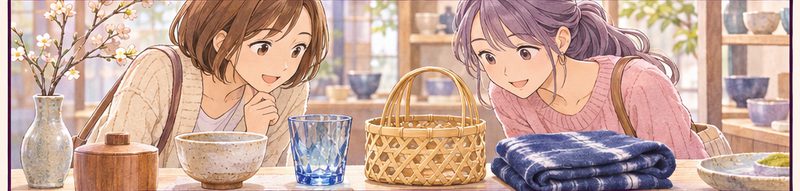
Let's start with things we'd like to use every day.
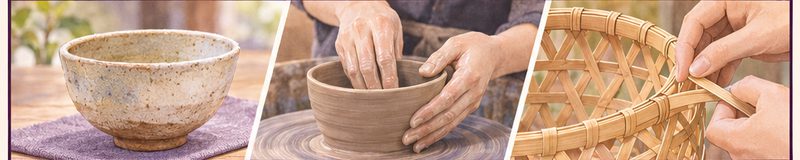
The national designation has five requirements, such as being used in daily life and being made mainly by hand.

Under the national system, it means items that meet the requirements and are designated by the Minister of Economy, Trade and Industry.

Lacquerware, textiles, washi paper, brushes and ink sticks have designated items too.
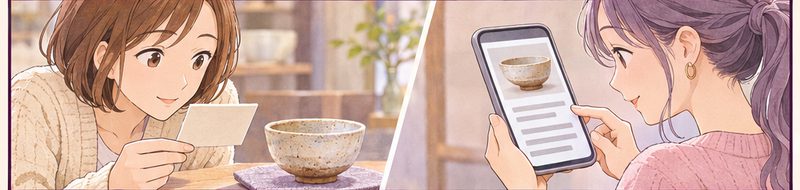
Don't decide by the name alone. Check how it's made, the materials and details like the Dento Shoshi seal.

Check its use and care too, and choose one that suits your life.
The comic is an illustration to explain the system and ways to enjoy crafts. The characters and items drawn are fictional and do not show whether any product is designated. The illustrations are original images made by this site using generative AI.
What is a "traditional craft product"?
The words "traditional crafts" may bring to mind handwork passed down over generations. Among them, "traditional craft products" under the national system are items that meet requirements set by law and are designated by the Minister of Economy, Trade and Industry.
According to METI, there are five requirements (summarized for easy reading):
- Used mainly in daily life
- The main parts of the making process are done by hand
- Made with traditional techniques and methods
- Made mainly from traditionally used materials
- Made by a fair number of people in a certain region
So looking Japanese, or being handmade, is not enough on its own to be a nationally designated "traditional craft product."
247 designated items
In METI's announcement of October 22, 2026, the number of traditional craft products became 247. On that day, "Hakone-Odawara karakuri woodwork," "Kyoto bamboo craft" and "Kyoto cloisonne" were newly designated.
This number is as of October 22, 2026. Designated items and their details can be updated, so when you look things up, check the date of the source too.
What does the "Dento Shoshi" seal mean?
According to the Association for the Promotion of Traditional Craft Industries, products made with the designated techniques, methods and materials that pass a regional inspection carry a "Dento Shoshi" (traditional certificate seal) that uses the design of the traditional crafts mark.
What matters is to check each individual product, not just the region name. Even with the same region name, not every product sold in that area is made according to the designation. Check whether there is a Dento Shoshi seal and read the descriptions from the maker or seller.
At the same time, there is no need to judge a product's quality only because you cannot find a seal. Read the description while thinking about what you want to know.
Not only tableware: many kinds of crafts
Designated items include not only pottery and porcelain but also textiles, lacquerware, bamboo crafts, writing tools and more. Here are some examples chosen from the association's official list as places to start.
| Field | Examples of designated items |
|---|---|
| Pottery and porcelain | Imari/Arita ware, Mino ware, Kutani ware, Mashiko ware, Hasami ware |
| Glass | Edo Kiriko, Edo Glass |
| Lacquerware | Tsugaru-nuri, Wajima-nuri, Wakasa-nuri |
| Woodwork and bamboo | Odate Magewappa, Hakone Yosegi marquetry, Beppu bamboo craft, Takayama tea whisks |
| Textiles and dyeing | Nishijin-ori, Yuki-tsumugi, Kaga Yuzen, Ryukyu Bingata |
| Washi paper | Mino washi, Echizen washi, Tosa washi |
| Writing tools | Kumano brushes, Nara ink sticks, Suzuka ink sticks, Ogatsu inkstones |
| Dolls and kokeshi | Edo Kimekomi dolls, Hakata dolls, Miyagi traditional kokeshi |
| Metalwork | Nambu ironware, Tokyo silverware, Tsubame hammered copperware |
This table is not a complete list. Glass is included in "other crafts" in the official list by industry that we referred to; we show it separately to make it easier to find.
Start from the table: pottery
This site introduces Japanese pottery region by region. Why not pick a region that interests you and read about the background of its tableware?
These articles are for learning about regions and culture. They do not mean that every product introduced from them is made according to the national designation.
From matcha to its tools
When you enjoy matcha, look at the tools as well as the tea. For example, "Takayama tea whisks" (Takayama chasen) appear in the official list as one of the woodwork and bamboo crafts.
However, not every tea whisk is a Takayama chasen. When choosing matcha tools, check the region, materials and maker's description one by one. (See also our articles on usucha and koicha and matcha and tencha.)
To learn about glass crafts
On this site we also introduce Edo Kiriko from Tokyo and Ryukyu glass from Okinawa. Both are glass crafts, but Edo Kiriko shows patterns by cutting and polishing the surface, while Ryukyu glass is mainly shaped by glassblowing. The designations differ too: Edo Kiriko is a national traditional craft product, and Ryukyu glass is a "Prefecture-Designated Traditional Craft Product" of Okinawa.
What to check when looking for a product
When you find a craft you like, read the product description as well as looking at the photos.
- Where it was made: region, maker, country or region of origin
- What it is made of: materials, coating, finish
- Whether it is introduced as a designated item: a Dento Shoshi seal or specific details about the designation
- Whether it suits your life: size, weight, use, care
- Whether there are conditions for use: dishwasher, microwave, hot drinks and so on
When looking for tableware, chopsticks or matcha tools, checking these points product by product makes it easier to find what suits you. We recommend reading the system's category "traditional craft products" designated by the government separately from regional craft names and product names.
To see the real thing: Traditional Crafts Aoyama Square
If you find a craft you like on screen, going to see the real thing is the next step.
"Traditional Crafts Aoyama Square" in Akasaka, Tokyo, is a shop run by the Association for the Promotion of Traditional Craft Industries. According to the association, it holds events such as demonstrations by artisans, workshops for all ages and special exhibitions.
Before you visit, check opening days and hours, exhibitions, and demonstration or workshop schedules and conditions on the official site (in Japanese).
Start from "How would I use it?"
Looking for a bowl for tea. Choosing chopsticks for the table. Noticing the paper you write letters on. Looking for something you would like to use in daily life may be a good way to get to know crafts.
When you find a shape or color you like, read on little by little about its region, materials and how it is made. Why not make November's Traditional Crafts Month a chance to learn the background of everyday tools?
Tableware and everyday tools on this site
- Kutani ware lucky mini plates "Kissho" (Seikou kiln)
- Arita ware Nanban Ruri sashimi bowl and cup set
- Mino ware mini plates with Japanese patterns, set of 6
- Hasami ware neco plates, set of 5
- Yamanaka lacquer plate, 21cm
- Matcha tool set of 7
- Ebony chopsticks, Kamakura tortoiseshell pattern, blue
The products listed here are not presented as nationally designated traditional craft products. Check the region, materials and conditions for use on each product page and the linked Rakuten Ichiba product page. You can find more tableware on our Tableware & Bento page.
Product pages on this site include Rakuten Affiliate advertising links. The images in this article are craft-themed illustrations and do not show real products or products that are designated or have passed regional inspection.
Sources
- 経済産業省「令和7年度『伝統的工芸品月間国民会議全国大会』の開催地の決定」(in Japanese)
- 経済産業省「伝統的工芸品に関する法律について」(in Japanese)
- 経済産業省「箱根小田原からくり細工、京竹工芸及び京七宝を伝統的工芸品として新たに指定」(2026年10月22日)(in Japanese)
- 伝統的工芸品産業振興協会「伝統的工芸品指定品目一覧・業種別」(2024年10月17日現在)(in Japanese)
- 伝統的工芸品産業振興協会「協会について」(KOGEI WALK)(in Japanese)
The sources were checked on November 13, 2026. The number of designated items is from METI's announcement of October 22, 2026, and the examples by field are from the association's list as of October 17, 2024, so the reference dates differ by source. The system, designations and facility information may be updated. This article is our own composition based on official public information, with our suggestions for enjoying crafts in daily life.